
Exploring true Potential
Beyond the Local Maximum


As a highly driven person pursuing multiple passions, my agency and drive can be a double-edged sword: My expectations for high-quality performance often collide with my equally deep needs for safety, harmony and love. There is like a paradox built into the architecture of my core values. When I “succeed”, I rarely feel content. But when my progress stalls, I fall prone to a symmetric cognitive error, mistaking a temporary plateau for a final peak. I assume I have hit the absolute ceiling of my capacity and convince (or wish?) it is fine to just settle for comfort. But comfort I can’t allow, because I’m so afraid of being average, of not being good enough.
This internal friction distorts our understanding of what we are capable of. Even as highly independent, high-agency individuals, we are conditioned to look outward for a verdict, waiting for the world to define our limits or validate our efforts. But true potential is neither discovered through external validation alone, nor through introspection in isolation. It requires a rigorous, vulnerable examination of the systems within which our effort, motivation, and imagination operate.
The Illusion of the Local Maximum
In mathematics, a local maximum is a point that appears to be the highest peak within a limited range, even though a much higher peak (a global maximum) exists elsewhere on the curve. From where you stand, it feels like the top. But it is an illusion.
I experienced this firsthand during my football career. By any classical metric, I was performing well. I was fiercely disciplined, and convinced I was doing everything required to maximize my talent. In hindsight, the reality was entirely different: I was battling an eating disorder, leaving my system chronically under-resourced. I was doing well, but I lacked the physical and mental energy to explore further; my curiosity was dimmed, my beliefs constrained, and my world reduced according to my energy constraints.
Had you asked me then, my perception was entirely distorted. I would have told you I was doing everything right because I was trying incredibly hard. But effort was never the problem.
A plateau rarely represents a final verdict on your capacity. Instead, it is a diagnostic signal reflecting one of three realities:
A true systemic constraint
Severe under-resourcing (a lack of energy, time, psychological safety, or belief)
Misaligned execution, meaning your immense effort is being applied to the wrong variable altogether.
Capacity vs. Access
To navigate this, we must decouple two concepts that high achievers routinely conflate:
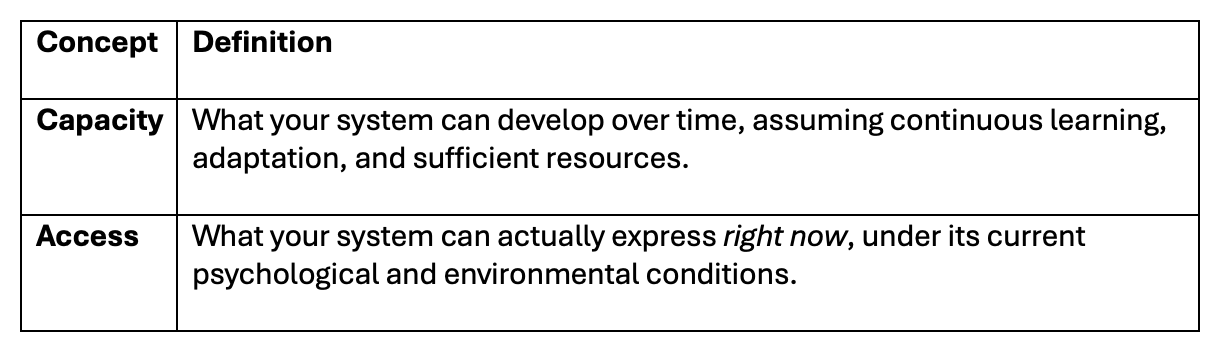
Most of our limitations are not failures of capacity. We stall because we mistake restricted access for a fixed ceiling. When you possess intelligence and agency, self-sabotage rarely looks like laziness; instead, it masquerades as hyper-performance, perfectionism, overworking, or overtraining.
These behaviors often originate as brilliant coping strategies that once served a purpose. We cling to the grueling struggle because it gives us a false sense of agency (“Look how hard I am working, I must be doing everything I can” ). But when struggle becomes “identity-protective”, it prevents true exploration of potential. Staying at a local maximum feels safe. Leaving it requires stepping into deep uncertainty - not just about the outcome, but about who you will become if you drop the armor of your struggle.
The Trap of Metric-Driven Potential
So, what is true potential if it isn’t a number, a role, a specific milestone, or a distant goal?
When we treat potential as something rigid or compare our trajectory to those who – at this point – are better or have “more”, we are trapped. We should avoid reducing a complex human life to a spreadsheet. For a highly analytical mind, hard data is a comfort, but without context, it becomes a weapon of self-discouragement. It blinds us to incremental progress and tempts us to abandon our own, authentic path to chase someone else’s version of success.
Potential is neither purely objective (facts, logic, data) nor purely subjective (intuition, feeling). It is an emergent quality of how you engage with the world. It shows up as:
The emotional resilience to tolerate uncertainty without shutting down.
The vulnerability to revise your identity when old narratives no longer fit your growth.
The imagination to conceive goals beyond your current reference points.
The wisdom to sustain high effort without self-destruction.
Potential lives in the “not yet”. It is just beyond what you can currently access, but entirely within reach if you cultivate the right conditions.
Calibrating “Enough”
However, the pursuit of potential or “the global maximum” can also create internal friction, especially when your ambition collides with other core values like safety and love.
As we approach our peak(s) professionally, athletically, emotionally or creatively, our perception can betray us. Instead of pausing to recognize our progress, we look around and compare, or we skip the celebration and jump on the “hedonic treadmill”. What once felt like hard-won growth suddenly feels inadequate. This obsession can ruin our foundations, our relationships or destabilize our mental health.
If you are a highly ambitious, but extremely sensitive person like me, you must apply your capacity for self-examination to a critical question: What does “good enough” mean to you?
Does your current version of success align with your deepest values, or are you simply trying to look good while running a race that has no finish line? There is a profound difference between the process of mastery, which is an internal, sacred dialogue between you and your craft, and achievement, which is often a frantic attempt to secure external validation and may even have little value in itself.
Designing the System for Sustainable Motion
If you want to explore your true potential without breaking your life, you must audit your environment before demanding more effort from your psyche.
Prioritize Stabilizers Over Intensity: True growth is an act of compounding, and compounding requires longevity. Choose consistency over destructive bursts of intensity. Protect your foundational stabilizers (your health, your relationships, your community, and your baseline joy) with the same fierce agency you bring to your ambitions.
Expand the Conditions of Access: Unlocking your capacity might simply mean also giving yourself the permission to rest, recover, and accept fuel (both literally and emotionally).
Seek Unconditional Perspective: Because we are often too close to our own complex narratives to see where we are restricting our own access, we need mirrors. Find people you trust, people who can offer unbiased perspective without imposing an agenda.
A Note of High-Agency Liberation: We are under no moral obligation to pursue our maximal potential at all costs. Settling for comfort, choosing stability, or prioritizing love and sufficiency over performance is not a failure; it possesses its own deep dignity.
There is a vast difference between being unable to access your potential due to unresolved trauma or poor conditions, and consciously choosing not to pursue it because your current horizon is beautiful.
Potential is not a finite resource to be aggressively mined until you run dry. It is a horizon to be explored. And like the horizon, it moves with you. As you approach it, it shifts, not to mock your lack of progress, but to invite you to stay in sustainable, joyful motion for the rest of your life.